CA Gubernatorial Candidate Steve Hilton Pitches Practical Reset on Taxes, Energy and Immigration
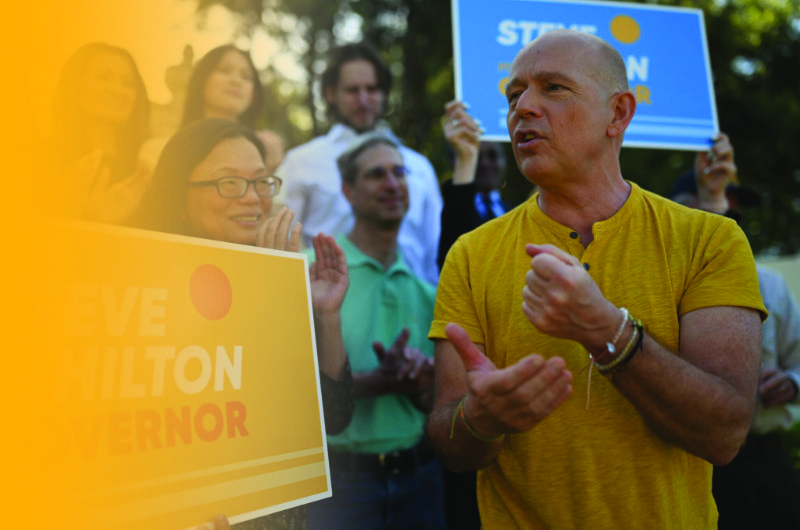
Republican gubernatorial candidate Steve Hilton is pitching a California affordability agenda built around tax cuts, lower energy costs, housing reform and a sharp break from the state’s current approach to federal immigration enforcement.
In a media briefing on May 19, hosted by American Community Media, Hilton said California under his leadership would not obstruct federal immigration enforcement, while arguing that the state needs a broad reset after what he described as years of single-party Democratic rule.
Hilton, 56, is seeking the Republican nomination in a governor’s race that will test whether the GOP can mount a serious challenge in a state that has not elected a Republican governor since Arnold Schwarzenegger left office in 2011.
The entrepreneur and former Fox News host immigrated from England and became a U.S. citizen. His parents were working-class Hungarian refugees, and Hilton framed his candidacy as both a defense of legal immigration and a critique of what he called 16 years of progressive governance in California.
“It’s been an experiment in progressive governance, which the party that’s been in charge uses to say it’s a model for the rest of the nation,” he told reporters. “Let’s just be real about the actual state of things in California right now.”
Affordability and Tax Cuts
Hilton’s campaign message is centered heavily on affordability, which he argued has become the defining issue for California families.
“Today, California has the highest poverty rate of any state. We’re tied with Louisiana for the top. We have the highest unemployment rate of all 50 states, the highest cost of living by far,” he continued, with “gas prices the highest in the country, electric bills the highest-ever except for Hawaii, highest housing costs, lowest home ownership … I’m arguing for a positive, practical change plan to make our state affordable.”
In its 2025 analysis, the U.S. News & World Report ranked California 50th out of 50 states for opportunity. In 2024, the most recent year of Bureau of Economic Analysis estimates, the state’s living costs were 11% higher than the U.S. average.
Hilton’s most immediate proposal is to eliminate state income tax on the first $100,000 of earnings.
“That’s the most quick and direct way we can lower costs, through what the government charges, the government taking money directly from people,” he said.
California has the highest combined income tax in the U.S., with a top rate of 14.6% on wages.
Hilton’s campaign estimates the tax proposal would cost roughly $8 billion a year. He argued that the state could absorb that cost by cutting what he described as an $80 billion “annual cost of waste and fraud and abuse in our budget.”
The figure comes from estimates by the campaign CAL DOGE, whose investigations found that roughly $425 billion was lost to “corruption, fraud, waste and abuse” in major state programs such as Medi-Cal and CalFresh over five years.
Hilton also proposed eliminating the $800 annual franchise tax that every small business currently pays, matching the federal no-tax-on-tips policy at the state level and capping vehicle registration fees at a flat $71 per year.
Energy, Housing and Education
Hilton said lowering energy costs would also be central to his affordability plan.
He argued that “reversing the damaging energy policies we have” could bring gas prices down to $3, “cut your electric bills in half, reduce the cost of housing,” though he acknowledged that such changes would take longer than tax cuts.
“The most direct way is to reduce taxes … (our) budget has nearly doubled in the last 10 years, and yet everything is worse,” he said.
On education, Hilton tied weak academic outcomes in reading and math to what he called “inappropriate spending.” He argued that California schools have placed too much emphasis “on these politicized things and not enough emphasis on the basics of teaching kids to read and write and do math.”
He said the consequences fall especially hard on low-income students and students of color, who are left without the basic credentials needed for upward mobility.
“You’re never going to have the chance of the California dream if you can’t read, if you can’t do math,” he said.
Legal Immigration and Federal Enforcement
Immigration was one of the most contested issues in the briefing.
Hilton, who arrived in California in 2012 and is now a citizen, described himself as “the candidate of the legal immigrant community for the legal immigrant community.”
He said that, as governor, he would take a different approach from California’s current leadership by not resisting federal immigration enforcement.
“The difference you will see with me as governor is that instead of the confrontational approach, which has led to some of these scenes that I don’t think any of us want to see — as we saw in Los Angeles last summer, or even worse, in Minneapolis earlier this year,” Hilton explained. “We will have an approach which is that all the laws must be peacefully enforced, and we will not obstruct the implementation of federal immigration law.”
Hilton argued that immigration policy falls under federal authority, not the governor’s office.
“Immigration policy is not a responsibility of the governor, it is a responsibility of the federal government, and I very much agree with all the arguments that have been made over the past few years by Democrats about the importance of honoring election results and not undermining democracy, and so the results of the last presidential election were very, very clear,” he said.
“One candidate, one party won all the swing states — a popular vote on a very clear platform on immigration policy, and the administration is now implementing the verdict of the people, and the question for the next governor of California is: Are you going to actively work against the results of the 2024 election when it comes to immigration policy or not?” he continued. “I don’t think that’s even an option, realistically, if you want to be true to your principles of upholding the Constitution and the rule of law, to actually obstruct the implementation of federal law.”
Farmworkers and Automation
When asked about the impact on California farmworkers, where approximately half of the workforce self-identifies as undocumented, Hilton rejected the idea that there is no domestic labor alternative.
He pointed to California’s declining labor force participation rate, which fell from more than 67% in 2000 to about 62.3% as of March 2026. He also estimated that four to five million able, working-age Californians are currently not in the workforce and are “being paid not to work by taxpayers through the welfare system.”
“I don’t think it’s a reasonable thing to have a system where we say we can’t find Americans to do these jobs, so we have to import labor from other countries illegally, while we have millions of Californians who are not working,” he said.
Hilton also pointed to agricultural automation as a force that could reshape farm labor, citing his experience at this year’s World Ag Expo in Tulare. He argued that automation would reduce the need for lower-paid farm labor and said California’s “union practices” were slowing the adoption of technologies already moving faster in states such as Oregon.
Healthcare for Undocumented Immigrants
On healthcare, Hilton said he would end state-funded coverage for undocumented immigrants, arguing that the policy is fiscally unsustainable and legally questionable.
Aside from already “distressed hospitals,” he said “I think it’s not reasonable to ask California taxpayers to pay money from their taxes to subsidize health care for citizens of other countries,” citing statements by national Democratic party leaders like Hakeem Jeffries and Chuck Schumer “who have made it clear that when it comes to federal law, it’s against the law for citizens of other countries to be receiving health care benefits other than that prescribed by Congress, and that’s the position I support for California.”
Hilton framed his campaign as an effort to restore economic mobility, especially for immigrant families who followed legal pathways.
“What I want to achieve is to restore that ladder of opportunity for every legal immigrant family,” he added. “I’ve lived the California dream, and the simple reason I’m running is that that dream is just not there for most people.”
Image courtesy of American Community Media