Let There Be Light – Nobel-winning Discovery Illuminates the Brain
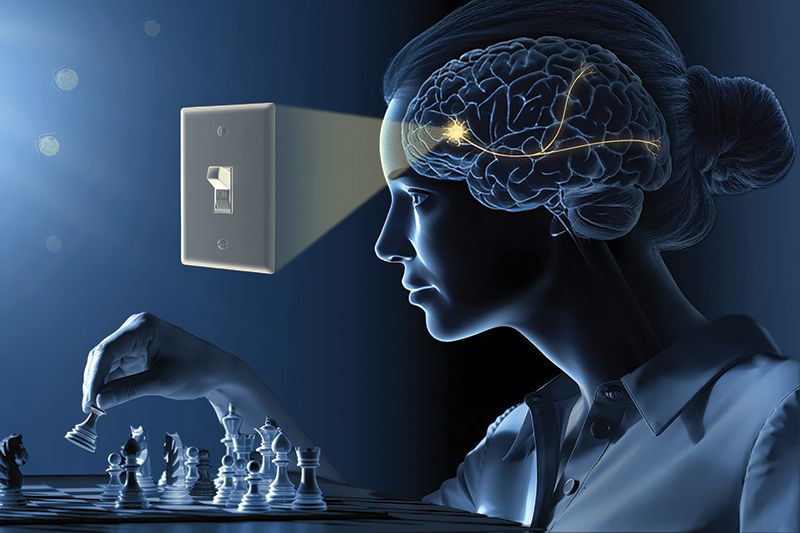
(Above): Illustration of scientist using a switch for nerve cells. (Mattias Karlén/The Nobel Assembly at Karolinska Institutet)
Astronomers mapped distant planets, physicists split atoms, and engineers built machines capable of imitating conversation. Yet the organ that makes all of that possible remains one of science’s greatest mysteries. Nobel prize-winning research can shed some light on how our brains are actually wired, writes Janam Gupta.
It’s 12:30 a.m. What’s happening? Maybe you are winding down for bed. Maybe you are enjoying a beer with an old friend. Maybe you are catching up on the report due tomorrow.
Karl Deisseroth was doing what he often does: working.
The Stanford psychiatrist and neuroscientist had been sending ideas to his students and working on papers when he decided it was time to turn in for the night. His children had school in the morning, and he was on breakfast and lunch duty. Just as he began drifting into a dream, his phone rang to tell him that it had come true.
For about 30 seconds, Deisseroth struggled to form words. He was caught between sleep and wakefulness, unsure of what was happening. Then it settled in.
Karl had been awarded the 2026 Nobel Prize in Physiology or Medicine.

Deisseroth shared the prize with Peter Hegemann and Georg Nagel for discoveries concerning light-gated ion channels and optogenetics: a method that allows scientists to control nerve cells using light.
The award recognizes more than a clever new technology, it marks a pivotal moment in how we study the brain.
The brain allows us to think, feel, remember, move, and make decisions. You are using it to read this article right now. Yet, researchers have long struggled to determine how individual cells contribute to those experiences.
Earlier, researchers could see that groups of cells became active during fear or movement, but they could not always determine whether those cells were actually producing the response.
The Nobel Committee compared this earlier understanding to a sketch map filled with question marks.
Optogenetics began to fill in some of those blanks.
In layman’s terms, optogenetics makes selected nerve cells responsive to light. Scientists use genes originally found in single-celled algae to give specific cells light-sensitive proteins. They can then use carefully directed light to switch those cells on or off.
“It’s a way of understanding what cells are actually doing in the body,” Deisseroth explained. “The only way to know what matters is to actually cause things to happen.”
The discovery began with Hegemann’s question about how algae swim toward light. Hegemann and Nagel eventually identified channelrhodopsin, a protein that allows light to trigger an electrical signal inside a cell.
In 2005, Deisseroth showed that the protein could trigger nerve signals in rat cells. Two years later, his team used the light-controlled system in the brains of living mice.
Hard to believe, right? A protein found in algae had become a switch for nerve cells.
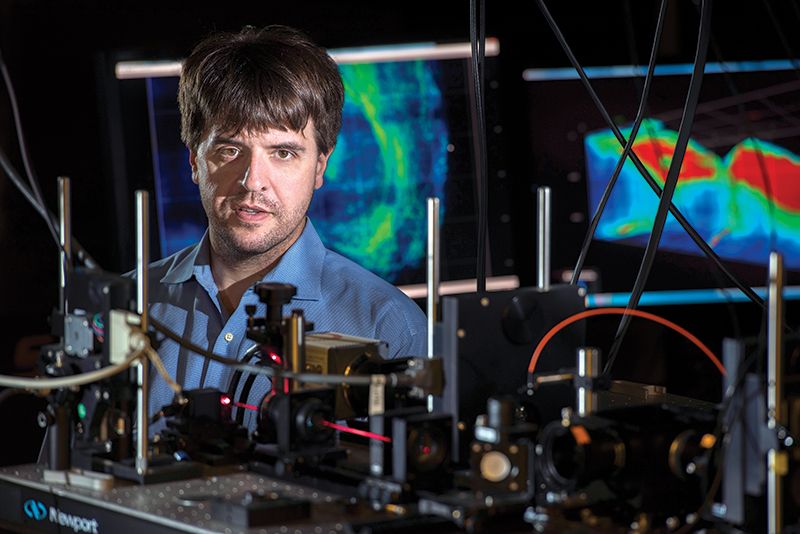
PRINT EDITION PHOTOS:
Cover Image:
Andrew Brodhead/Stanford University.
Content Page Image:
Jim Gensheimer
Optogenetics has helped researchers investigate depression, anxiety, autism, schizophrenia, Parkinson’s disease, and other neurological and psychiatric disorders.
Its most important contribution may be that it helps researchers identify which specific cells are connected to a disease.
Optogenetics can reveal the cells future medications, medical devices, or other treatments should target. Researchers have also explored its direct use in treating retinitis pigmentosa, a condition that can cause blindness. By making remaining retinal cells responsive to light, scientists have restored a degree of light sensitivity in some patients.
More than a century ago, psychologist William James wondered whether emotions existed entirely in the brain or whether the body helped create them. We don’t only feel afraid and then experience a racing heart; the physical reaction may also help create or intensify the feeling of fear.
Using optogenetics, Deisseroth controlled the cells responsible for the heart’s contractions in mice. They found that changes in the heart could influence anxiety-related behavior, although a complete emotional state required an interaction between the brain and the body.
“William James was right,” Deisseroth said, “but in a nuanced and context-specific way.”
It could also contribute to future brain-computer interfaces, which may one day help people affected by paralysis, stroke, or other neurological injuries communicate with the outside world more effectively.

It is almost paradoxical that we are using our own complex neural networks to figure out how they work. Billions of people use their brains every day, yet humanity still understands only a fraction of what happens inside them.
There is still much to learn, and the path from discovery to an approved treatment can take many years. But a protein from a single-celled organism has already helped illuminate one of humanity’s oldest mysteries.
The brain, once represented by a whole bunch of question marks, is beginning to come into focus.
Siliconeer Print September-October 2026. Click here to view