California Leads Coalition to Halt Trump’s Public Charge Rule as Fear Grips Immigrant Families
Immigrants across California are facing a wave of anxiety following the September 18 implementation of the Trump Administration’s new public charge rule, which dramatically expands how participation in means-tested benefits affects eligibility for legal residency. The rule has already triggered a significant “chilling effect,” prompting thousands of eligible Californians—particularly those in mixed-status families—to drop out of essential programs like healthcare and food assistance over fears their status will be jeopardized.
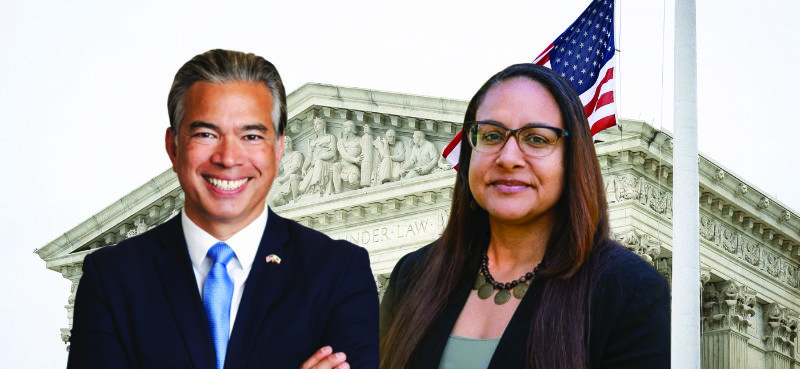
In a media briefing on September 24 hosted by American Community Media, California Attorney General Rob Bonta and CalHHS Secretary Kim Johnson discussed the state’s aggressive legal pushback against the policy alongside its tangible impact on public health and social safety nets. The speakers outlined the legal arguments driving their coalition of 22 states, emphasized who is actually exempt from the rule, and warned of the compounding financial crises looming for California’s vulnerable populations due to the rule combined with federal budget cuts.
Speakers
- Rob Bonta, California Attorney General
- Kim Johnson, Secretary, California Health & Human Services Agency (CalHHS)
A Coalition United in Legal Confidence
California and a coalition of 21 other states have filed a comprehensive lawsuit to prevent the implementation of the administration’s new public charge rule. Attorney General Rob Bonta emphasized that the state is prepared to fight this legal battle across all levels of the judiciary, citing recent precedents where courts successfully checked executive overreach. He pointed specifically to the September 14 Supreme Court order blocking the USPS mail ballot rule as evidence of judicial willingness to rein in rapid administrative actions that lack sufficient implementation time or legal grounding.
“I’ve said this before and I’ll say it again here: we’re confident in any court,” Bonta said. “We believe we have the facts and the law on our side.”
He argued that the rule represents an unlawful expansion of federal power. The administration’s new policy allows immigration officials to use participation in means-tested public benefits programs as grounds to deny lawful permanent residency—a move critics say effectively punishes families for accessing services their children are legally entitled to. Bonta stressed that Congress never intended for immigration officers to possess unchecked discretion over residency status based on benefit usage.
“If a child is a U.S. citizen but their parents are not, under this rule, the benefits that child lawfully receives can be held against their parents,” he noted. “The administration wants to punish immigrant families for using benefits that their children are completely legally entitled to.”
While the litigation is ongoing, Bonta expressed hope that the case might be resolved before reaching the U.S. Supreme Court but maintained that if it does go higher, the administration’s actions are vulnerable to strict legal scrutiny. “If you just look at the law and apply it to the facts, we should prevail,” he stated.
The Chilling Effect on Essential Services
Beyond the courtroom, CalHHS Secretary Kim Johnson outlined the immediate, terrifying reality for millions of Californians navigating the rule. The administration’s previous attempt at a public charge policy in 2020 resulted in a significant “chilling effect” where eligible individuals disenrolled from critical services; Johnson warned that current fears are driving the same destructive pattern right now.
“All across California, there is so much fear, so much concern, so much thinking about what this means for people individually, and for their family, in terms of health, access to food supports and other resources within our broader health and human services safety net,” Johnson said. “And we know that this is very much intentionally chaotic.”
She emphasized that the administration’s strategy relies on creating confusion to scare vulnerable populations out of the system entirely. “This rule could affect millions of families, U.S. citizens and non-citizens alike,” she added. “When you tell families that getting help with groceries, healthcare, rent could be used against them in an immigration decision, people stop getting the help they need.”
Johnson urged residents to consult trusted experts before making the “terribly hard decision” to disenroll from resources. She highlighted the California Department of Social Services’ newly released guide on public charge immigration questions and warned against scammers posing as attorneys in this climate of fear. However, she did attempt to provide clarity on who is actually exempt.
Exemptions and Broader Federal Impacts
The rule does not impact every immigrant seeking residency. Refugees, asylees, certain humanitarian immigrants, lawful permanent residents applying for citizenship, and those simply renewing green cards are generally exempt from the public charge inadmissibility ground. Undocumented individuals without a pathway to legal status are also not affected by this specific rule.
Despite these exemptions, Johnson noted that the compounding effects of the rule with recent federal budget legislation—specifically the GOP’s spending package HR1—will severely strain California’s infrastructure. She pointed out that HR1 rips almost $1 trillion from the Medicaid/Medi-Cal budget and $187 billion from the Supplemental Nutrition Assistance Program over the next eight years.
“We can’t possibly mitigate it all just by simply backfilling with state dollars,” Johnson said, warning that emergency room visits are expected to rise as uninsured populations lose coverage. “So yes, people will begin experiencing the impacts of this policy above and beyond the public charge experience.”
The context for these fears is further complicated by a shrinking safety net on the national level. KFF reported that Affordable Care Act enrollment has dropped by 3 million across the country as of June 2026. Johnson noted that while Vice President JD Vance recently claimed hundreds of thousands were fraudulently enrolled, the broader trend of disenrollment leaves millions without coverage just as federal healthcare support is being slashed.
For state officials, the priority remains mitigating a dual crisis: a legal battle against the administration’s regulatory overreach and a domestic emergency where citizens are too afraid to access the resources they desperately need.
Images courtesy of American Community Media