Black Voters Face a Midterm Test of Turnout, Representation, and Political Power
Black voters remain one of the Democratic Party’s most consistent constituencies, but the 2026 midterms are testing more than partisan loyalty. Turnout, economic frustration and changes to voting-rights law could all determine whether Black electoral strength translates into representation at the ballot box. The stakes are particularly visible in the South, where redistricting battles are reshaping congressional districts only weeks before voters head to the polls. At the same time, organizers say campaigns cannot assume that younger Black voters and Black men will turn out simply because they have traditionally favored Democrats.
In a media briefing on October 2 hosted by American Community Media, a panel of experts discussed the Black vote in 2026, including turnout, political engagement, voting-rights litigation and efforts to mobilize Black men.
The question is not simply which party Black voters prefer, but whether they participate at rates high enough to influence closely contested races — and whether the districts in which they vote allow them to translate those votes into political representation. Those questions have grown more urgent as changes in voting-rights jurisprudence alter the legal tools available to challenge congressional maps.
Speakers:
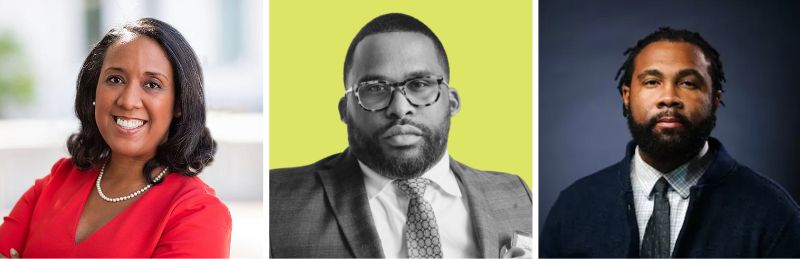
• Dr. Andra Gillespie, Political scientist at Emory University specializing in Black politics and electoral behavior
• Michael Bland, Executive Director, Black Men Vote
• Evan Milligan, Voting-rights advocate; lead plaintiff in Allen v. Milligan; founder and former executive director of Alabama Forward
Alabama becomes a test of Black representation
Few states illustrate the stakes more clearly than Alabama.
The legal fight over its congressional map has stretched across multiple election cycles. In 2023, the Supreme Court’s decision in Allen v. Milligan upheld a challenge under Section 2 of the Voting Rights Act to Alabama’s congressional map, which had concentrated many of the state’s Black voters in a single district.
Evan Milligan, the lead plaintiff in that case, said Alabama officials continued resisting the legal challenge even after the Supreme Court ruling.
“Our state didn’t listen to these rules,” Milligan said. “They continued to thumb their nose at it, so we remained in court.”
A court-drawn map used in 2024 increased Black voting strength in Alabama’s 2nd Congressional District and helped produce the election of Rep. Shomari Figures, a Democrat and the district’s first Black representative in more than 150 years.
But the legal landscape shifted again this year.
In April, the Supreme Court’s ruling in Louisiana v. Callais significantly tightened the framework for Section 2 vote-dilution claims. The Court held that liability requires circumstances giving rise to a strong inference that a state intentionally disadvantaged minority voters because of race, while also requiring challengers to separate racial effects from partisan considerations. Legal Information Institute
Milligan characterized the broader legal environment as leaving Black voters in “a more vulnerable and precarious position” than when the Alabama litigation began.
Alabama subsequently returned to its 2023 congressional map for the 2026 elections. The new boundaries reduced the Black population of the 2nd District from roughly half to about 40%. When voters returned for an Aug. 11 special congressional primary under those lines, statewide turnout was approximately 5%. Figures was unopposed on the Democratic side, while state Rep. Rhett Marques won the Republican nomination. WBHM 90.3
For Milligan, Alabama’s experience carries implications extending far beyond one congressional district.
“The protection of the legal infrastructure around multiracial, open, transparent voting in this country is being dismantled before our eyes,” he said.
Turnout may matter more than partisan switching
Despite Republican gains among Black voters in 2024, Andra Gillespie cautioned against interpreting one election as evidence of a wholesale partisan realignment.
“It’s going to take another 20 years before I know that that’s true,” Gillespie said.
Black voters continue to vote overwhelmingly Democratic. Pew Research Center’s analysis of validated 2024 voters found that 83% of Black voters supported Kamala Harris, while 15% supported Donald Trump. Trump’s share nevertheless nearly doubled from 8% in 2020. Among Black men specifically, 21% supported Trump in 2024. Pew Research Center
The more consequential variable in 2026 may therefore be participation.
Midterm electorates generally differ from presidential electorates, with fewer low-propensity voters participating. Gillespie said Black Americans represent a larger share of the population than they have recently represented among midterm voters, leaving significant potential for turnout growth.
Polls present another challenge. Gillespie noted that surveys looking specifically at Black voters often have relatively small Black subsamples, producing large margins of error and making sweeping conclusions about changes within the electorate difficult.
Economic concerns are also shaping the environment.
For many Black voters, affordability, employment and financial security are not separate from electoral politics. Those pressures can influence both political preferences and the practical ability to vote, particularly among people balancing multiple jobs, limited transportation or less flexible work schedules.
Gillespie said barriers associated with income, education and work flexibility tend to become more significant during lower-turnout, off-presidential election years.
Reaching Black men differently
Michael Bland said campaigns have repeatedly struggled to communicate effectively with Black men — especially those who vote inconsistently.
“They don’t get mail, they don’t get text messages, they don’t get asked to join a focus group or be a part of the real studies that move the electorate,” Bland said.
He argued that political outreach to Black men has too often centered on a narrow set of themes while overlooking issues that emerge repeatedly in his organization’s research.
“For the last 20 to 25, maybe even 30 years, the message to the Black male constituency has been recidivism. It has been marijuana,” Bland said.
Black Men Vote’s research, he said, instead identifies workforce opportunities, entrepreneurship, education and mental health as recurring priorities.
For voters between 18 and 45, Bland said the most effective political language often comes back to economic results.
“The winning strategy is economy,” he said, describing the question many voters are asking as: “How can you help put money in my pocket? I did everything you asked me to do, and I’m still getting screwed on the back end.”
Bland also said Donald Trump’s appeal to some Black men should not be reduced to personality or campaign theatrics. He pointed instead to Trump’s long-standing public image as a businessman and comeback figure.
“We remember the ‘Art of the Deal.’ We remember ‘The Apprentice.’ ‘I failed and made it back. I failed and made it back.’ That story resonates with Black America,” Bland said.
That does not mean Black men are becoming a Republican constituency. Pew’s 2024 results still showed a large majority voting Democratic. But Bland sees inconsistent Black male voters as a potentially consequential group in closely divided statewide contests.
Building turnout through trusted messengers
Black Men Vote is working with organizations including 100 Black Men of America, the National Urban League and the NAACP to mobilize Black male voters ahead of the midterms.
The strategy includes phone banking, digital storytelling, outreach through YouTube and gaming platforms, and organizing through barbershops, churches, union halls and college campuses.
But Bland said the most effective messengers are not always celebrities or national political figures.
“We’re constantly trying to provide spaces where Black men can talk, and they’re not being talked at. They’re actually being listened to,” he said.
Participants in the organization’s focus groups, he said, frequently identify local leaders — city council members, youth coaches and others with direct community relationships — as more persuasive than famous athletes brought into campaigns to encourage turnout.
“The people who are going to get us to vote are our city councilmen, the AAU coaches, the AYF coaches, the folks that really have skin in the game in the community,” Bland said.
His advice to political candidates is equally direct.
“You got to figure out how to get Tyrone off the couch,” Bland said, using “Tyrone” as shorthand for the sporadic voter who does not respond automatically to traditional partisan messaging.
The challenge facing campaigns in November is therefore twofold. Black voters must have meaningful opportunities to elect candidates of their choice, even as the legal landscape governing voting rights and redistricting changes. And candidates and civic organizations must persuade eligible voters that participating is worth their time.
The 2026 election will offer another measure of whether the shifts seen in 2024 represented lasting partisan movement or primarily differences in who showed up. Pew’s post-election analysis found turnout changes, rather than large-scale switching between parties, drove much of the movement among demographic groups in 2024. Pew Research Center
For Black voters, that makes turnout not a secondary consideration, but one of the central forces that could determine their political influence in November.
All images courtesy of American Community Media