Beating Traffic – AI Model Predicts Traffic Jams Early
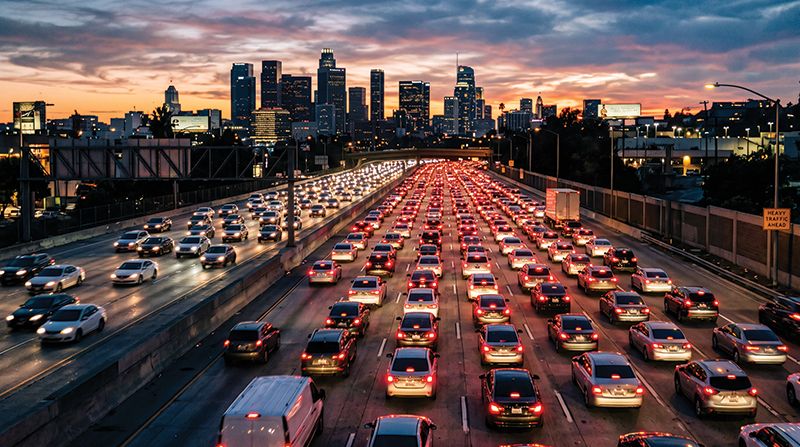
(Above): Commute hour traffic on 405 freeway in Los Angeles. (Adobe Firefly)
It’s an open-source AI tool that predicts urban traffic congestion more than 30% more accurately than standard methods. The model was tested using Los Angeles freeway data, writes doctoral researcher Mayank Vadaliya.
Anyone who has crawled through rush-hour traffic knows the feeling: you are already late, the road ahead is a red river of brake lights, and there was no warning. What if the road could tell you the jam was coming a few minutes before it did, early enough for the traffic system, or your own car, to do something about it?
That question is the heart of my research. I am a doctoral researcher in information technology, and I built an open-source tool that predicts how congested a stretch of road will be in the near future. In testing, it predicted traffic conditions more than 30% more accurately than the usual methods used on their own.
Predicting traffic depends on several different things at once: the shape of the road network, the rhythm of the day — a Monday morning is not a Sunday night — and dozens of smaller signals like weather and nearby incidents. Most tools are good at one of these and weaker at the others.
My approach combines three kinds of AI that are usually used separately, each doing the part it does best. One reads spatial patterns across the road network, one follows how traffic changes over time, and one weighs the many smaller factors. Put together, they cover each other’s blind spots.
I used METR-LA, a public dataset from the freeway sensors of Los Angeles, one of the most studied and most congested road networks in the world, to test it. The combined tool beat each of the three individual methods by a clear margin.
The model is practical and clever. It is open source and free. Any city or transit agency can use it without paying for expensive proprietary software. It is designed to plug into the cloud and roadside computing systems that cities are already buying, so it does not require tearing anything out and starting over.
None of this replaces good urban planning or better public transport. A prediction is only useful if a city acts on it. But a better, cheaper forecasting gives planners and engineers a clearer picture of what is coming, and a head start on doing something about it. The interesting problem now is less about the algorithm and more about the gap between what is already possible and what reaches our roads.
The views expressed in this writing are my own. They have not been reviewed or approved by Tesla.