Trump Wants to End Birthright Citizenship – Can He?
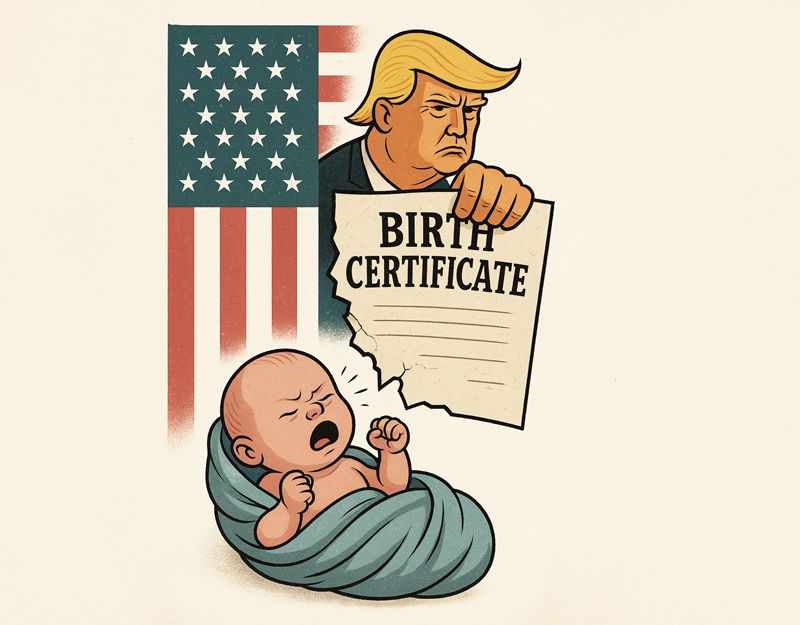
On his first day back in office, President Trump signed Executive Order 14160 — a sweeping move to redefine who qualifies as an American citizen. Now, the Supreme Court is weighing its constitutionality.
In a media briefing on May 16, hosted by American Community Media, a panel of experts gathered to discuss if there is any legal merit to Trump’s executive order to end birthright citizenship.
Speakers
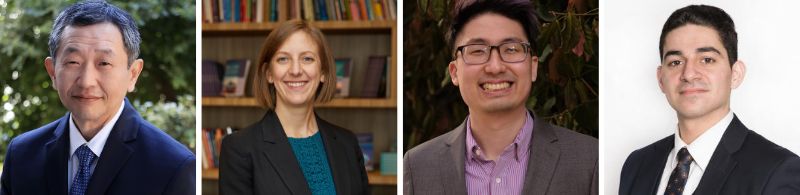
- Professor Robert S. Chang, Executive Director, Korematsu Center for Law & Equality at UC Irvine School of Law
- Julia Gelatt, Associate Director of the US Immigration Policy Program at the Migration Policy Institute
- Martin Kim, Director of Immigration Advocacy at Asian Americans Advancing Justice | AAJC
- Cesar Ruiz, Associate Counsel at LatinoJustice
At the heart of the executive order is a new restriction: children born in the U.S. to a mother who is either undocumented or on temporary legal status, and a father who is neither a citizen nor a lawful permanent resident, would no longer be granted automatic citizenship.
On May 15, the Supreme Court heard arguments challenging the order. Plaintiffs argue that it directly conflicts with the 14th Amendment’s Citizenship Clause, added in 1868, which affirms: “All persons born or naturalized in the United States, and subject to the jurisdiction thereof, are citizens.”
“Trump’s executive order is based on a fringe legal theory that tries to expand the one limiting clause of the 14th Amendment ‘subject to the jurisdiction thereof,’” said Martin Kim.
Federal judges in Washington, Maryland, and Massachusetts quickly blocked the order, issuing nationwide injunctions. The Supreme Court hearing focused not only on the legality of the birthright provision itself, but also on whether lower court judges have the power to halt executive orders on a national scale — a debate rooted in the separation of powers outlined in Article III of the Constitution.
The current case consolidates three lawsuits filed by 22 states and multiple immigration advocacy groups. However, Kim cautioned that the Court’s upcoming decision may not directly resolve the order’s legality. “The three cases that were heard, they’re coming out of an emergency appeal,” he said. “But it’s our position that the president cannot change the Constitution through an executive order, cannot sign a piece of paper that says these people are citizens and these people are not.”
The order is prospective, applying to children born on or after February 19, 2025. But its implications are profound. “But the actual argument that Trump’s administration is making, is that the President has the power to unilaterally decide who gets to be a citizen in the U.S., and that is obviously a very dangerous proposition.” Kim noted.
New projections from the Migration Policy Institute and Penn State suggest that if upheld, the order would balloon the undocumented population by 2.7 million by 2045 — and 5.4 million by 2075. Each year, roughly 255,000 children born in the U.S. would be denied legal status.
“The goal of President Trump’s executive order is to reduce illegal immigration and to shrink the size of the unauthorized immigrant population,” said Julia Gelatt. “But if you look at the likely impacts, it would do the exact opposite.” It would create a permanent underclass — U.S.-born children without rights, without legal identity, and without access to education, healthcare, or jobs.
By 2075, analysts estimate 1.7 million children born in the U.S. to U.S.-born parents would nonetheless lack citizenship. Gelatt warns us that this would affect not just one generation — it would reshape American society for decades.
Historically, immigrants and their U.S.-born children have driven 70% of all labor force growth from 1995 to 2022. Beyond human rights concerns, Gelatt said the policy would impose “massive administrative burdens” on all citizens, not just immigrants. This “would create big administrative costs and burdens that would affect not just immigrants but all of us, as we would face administrative burdens and paperwork challenges to prove our citizenship and that citizenship of our children born here.”
Cesar Ruiz echoed that concern. “Birthright citizenship only continues the administration’s practice of targeting the Latino community.” LatinoJustice filed a lawsuit in New York not included in the current Supreme Court docket.
Ruiz cited past deportations of legal residents, including Kilmar Abrego — a Salvadoran green card holder wrongfully removed despite following all legal protocols. “The administration admitted that, and there’s still a fight to bring this person home,” Ruiz said. “We firmly believe that no president should have the power to simply rewrite our Constitution. That power is reserved for the people.”
The broader stakes of the order worry legal experts. Robert S. Chang. “But if the US Supreme Court upholds this, it creates the risk that everybody who has parents in those two categories who are no longer US citizens, well, they could have the U.S. government denaturalize them,” he said. It’s about drawing new boundaries around who belongs.
This isn’t just a legal battle. Chang explained that its a cultural one — about who gets to be part of the national community. And once that door is cracked open, there’s no telling how far it might swing.
Even if the Court strikes down the order, Chang fears it’s part of a longer game. “It raises the question: Should we rethink who gets to be part of this nation? It opens up this question in a way that I think is very dangerous during this political moment.”
Speaker images provided by ACoM. Featured image generated using ChatGPT.