Tech.Talk: When Tech Gets Thoughtful – 2025 Responsible Innovation in AI Conference
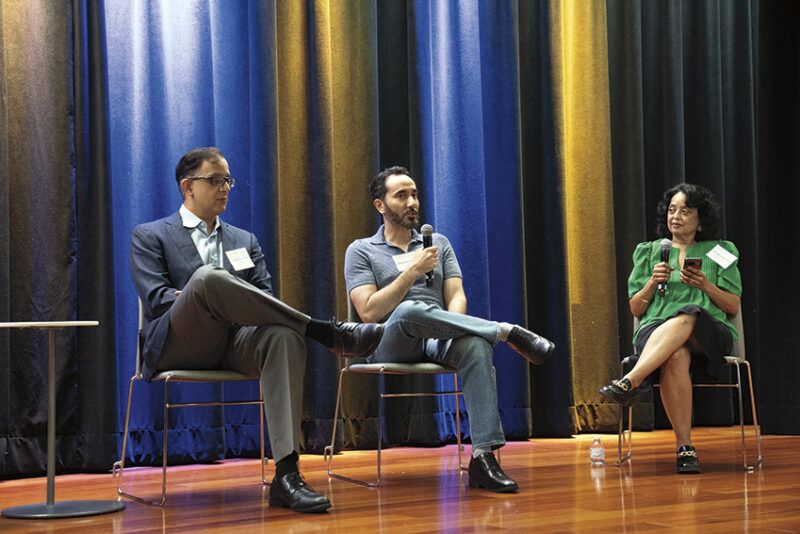
(L-r): Kabir Chaturvedi, CEO of Synapsell, Ehsan Kamalinejad, CTO of Cognichip, and Vasudha Badri-Paul, Conference Chair (Adriana Avila/San José State University).
San José State University brought over 300 industry leaders, academics, and entrepreneurs to tackle AI’s most pressing question: How do we build it responsibly? Meghna Paul reports on the insights from the second annual Responsible Innovation in Artificial Intelligence Conference.
With over 300 RSVPs, this year’s event—building on its 2024 success—brought together a diverse group of industry leaders, academic experts, students, and entrepreneurs to explore how artificial intelligence can be developed, deployed, and governed responsibly.
The program opened with a welcome from Nick Larson, host of Silicon Zombies, who addressed the persistent tension between innovation and responsibility. Conference co-chairs Professor Anuradha Basu and Vasudha Badri-Paul encouraged participants to engage as active contributors shaping AI’s future.
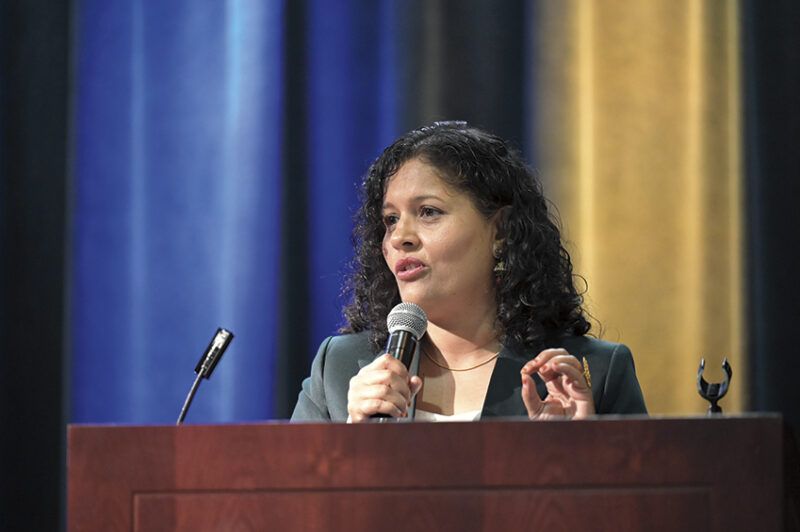
University leadership joined in the opening remarks, with SJSU President Cynthia Teniente-Matson and College of Business Dean Rangapriya (Priya) Kannan emphasizing SJSU’s commitment to responsible innovation supporting its mission of preparing students and communities for an AI-powered world. Following the remarks, Saeed Amidi, CEO of Plug and Play, reflected on Silicon Valley’s role in fostering responsible technology development.
The first keynote came from Stephen Caines, Chief Innovation Officer for the City of San José, who stressed the responsibility cities have in deploying AI equitably. A fireside chat followed with Shanker Trivedi, Senior Vice President at NVIDIA, and Surbhi Kaul, Vice President at Cisco. Their discussion explored enterprise adoption of AI, balancing the transformative power of AI with ethical guardrails.
The Education Track featured perspectives from global leaders and university scholars. Nupur Jain of Google DeepMind and Dr. Joseph Grzywacz, Associate Dean for Research in SJSU’s College of Health and Human Sciences, delivered keynotes on AI’s role in advancing research and learning.
A panel moderated by Dr. Yingjie Liu, Director of Digital Learning Strategies at SJSU, included panelists from Khan Academy, Copal AI, Edvisor.ai, and SJSU faculty. They discussed AI’s impact on education, highlighting barriers such as regulation and institutional inertia. They also point to stronger partnership opportunities and creative classroom applications.
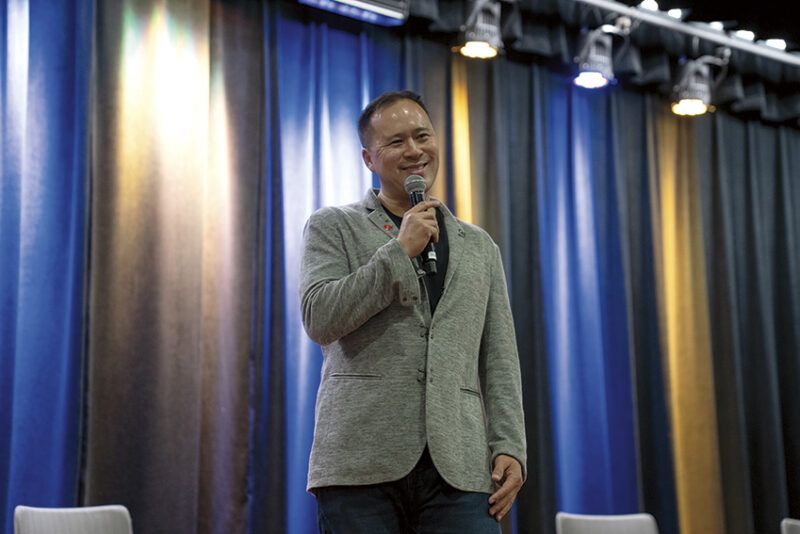
After a networking break, attention shifted to the Business students. Keynotes were delivered by Jeremiah Owyang, Blitzscaling Ventures, and Alison Richards, Intel Corporation and UXL Foundation, followed by a lightning talk from Animesh Koratana, CEO of PlayerZero.
Some notable takeaways from Owyang included the organizational approaches to AI: from the late adopters who wait until technology is proven before implementation to the AI-Native Startups with radically AI-integrated operations. The key insight is that “everyone is now a manager” – even individual contributors must learn to manage “fleets, groups, and swarms of AI agents that are completing tasks even while you’re sleeping.”
The AI in Business panel examined real-world implementations and ROI. Led by Vasudha Badri-Paul, the panelists include Dave Park, Founder of Narada AI, Kabir Chaturvedi, CEO of Synapsell, Ehsan Kamalinejad, CTO of Cognichip and Christopher C. McKinnon, Partner at Morrison Foerster Law. Insights on product development, commercialization, and scaling were shared. Audience questions pushed dialogue toward issues of bias, accountability, and sustainability in the age of AI.
Notable takeaways included: “Charge money, don’t give your initial product away for free,” “AI can handle mundane tasks so we can think more creatively,” and “Socially, we should all be involved in AI decision-making.”
The most contentious discussion centered on AI’s impact on employment, with sharply diverging views. The AI-Optimist believe automating mundane tasks give space for creative problem solving. The more pessimistic view came from Kamalinejad. “AI eventually is gonna eat up most of jobs… AI by nature is a force that concentrates power and wealth.”
The final track explored venture capital. Moderated by Shashi Tripathi of Nurture Growth Fund, the session featured Ray Wu of Alumni Ventures, Denise Teng of Gradient Ventures, and Tallulah Le Merle of 5th Era Partners. The future of AI investment depends not only on financial returns but also on social impact and deep ecosystem integration.
Building and using AI responsibly is not solely the task of technologists, but rather a shared responsibility of everyone involved. From classrooms to boardrooms to city halls, the conversation around AI must include diverse voices—because the technology will affect us all.