Startup.Talk: The Last Man Standing – Tech Honchos Talk Cybersecurity
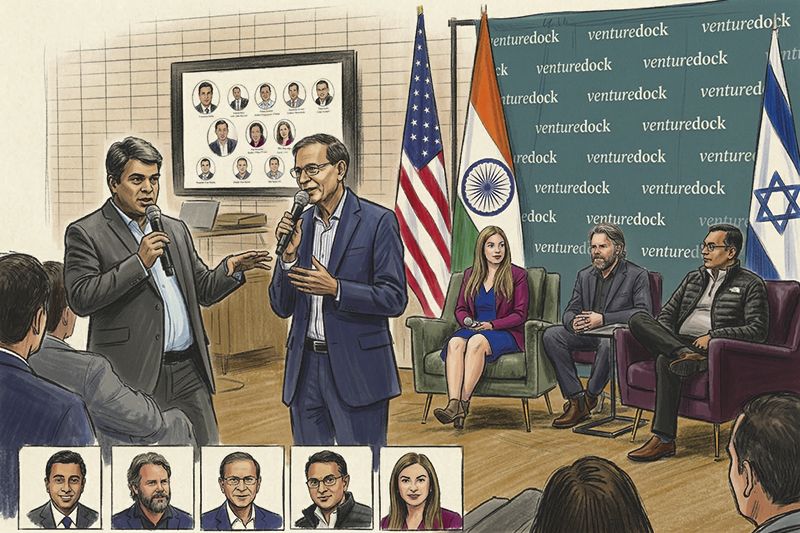
An artistic rendition generated of the India-Israel AI & Cyber Connect event held at Venture Dock, Palo Alto, Calif. (L-r); Vivek Vipul, Jay Chaudhry, Alice Shaff, Glenn Chisholm, and Debanjan Saha. Pictured on the bottom are Raj Judge, Oren Zeev and Guru Chahal (Google Gemini/Venture Dock).
With the meteoric rise of AI agents in cyberspace, a new opportunity emerges within the cybersecurity sector. Siliconeer shares key insights from Silicon Valley’s think tank, including Zscaler CEO Jay Chaudhry, investors Guru Chahal, Oren Zeev, Glenn Chisholm, and others.
On a packed evening at Venture Dock in Palo Alto, the Consul Generals of India and Israel, a billionaire founder, a legendary solo-GP venture capitalist, and a room full of entrepreneurs and investors gathered for an eye-opening conversation about the collision of artificial intelligence and cybersecurity. The India-Israel AI & Cyber Connect — co-hosted by the Consulate General of India in San Francisco, the Consulate of Israel, and Venture Dock — brought together experts to discuss the impact, threats, and emerging opportunities in cybersecurity amid the explosive growth of AI.
The evening opened with remarks from Venture Dock’s Vivek Vipul, followed by a keynote from Jay Chaudhry, founder and CEO of Zscaler. A panel featuring Guru Chahal of Lightspeed Ventures, Glenn Chisholm of SYN Ventures, Debanjan Saha of DataRobot, Gadi Bashvitz of Bright Security, and Alice Shaff of Gator Security followed. The evening closed with a fireside chat between Oren Zeev of Zeev Ventures and moderator Gopi Rangan of SureVentures, and startup pitches from Zluri and Scrut.
What emerged over nearly three hours was a layered, sobering, and captivating portrait of an industry undergoing fundamental transformation.
Chaudhry was unequivocal: AI represents a far bigger wave than the internet, mobile, or cloud — and it is simultaneously the most powerful tool and the most dangerous threat the cybersecurity industry has ever faced. AI has compressed the attacker’s timeline from weeks to seconds. Ask an AI to identify all firewalls and VPNs at a given company with known vulnerabilities, and you get a tabulated answer in thirty seconds. Ask it to write a phishing email mimicking a company’s CFO, and the old broken-English Nigerian scam is replaced by polished, nearly undetectable social engineering.
But the most alarming threat, in Chaudhry’s view, isn’t AI-powered phishing or automated vulnerability scanning. It’s AI agents themselves.
“Today, the user is the weakest link. Tomorrow, AI agents will be your weakest link. Imagine agents getting hijacked. They’re inside your enterprise with access to everything.”

The panel amplified the warning. Guru Chahal estimated that for every employee, companies may soon have 50 to 100 AI agents operating autonomously. Agents that will need identities, access permissions, and governance frameworks that don’t yet exist.
Gadi Bashvitz of Bright Security offered a striking data point: AI-assisted coding has doubled developer productivity, but the volume of vulnerabilities introduced has grown sixfold. Developers are generating 200 percent more code but 600 percent more vulnerabilities. He illustrated the stakes with a real example — a customer’s VP of Marketing used AI coding tools to push a landing page directly into production six days before the Super Bowl, bypassing the company’s entire application security process and introducing critical vulnerabilities. Bright Security had to re-architect the customer’s AppSec program before game day.
Alice Shaff of Gator Security is a former Israeli military intelligence officer and 15-year Google Cloud veteran. She described autonomous AI agents as new employees who show up on day one without onboarding or supervision. Her company treats agents like children who need training, guardrails, and policy-driven oversight, especially in regulated industries like banking and government.
In the fireside chat, Oren Zeev of Zeev Ventures was cautiously optimistic. He described AI as the most powerful force since the dawn of technology, capable of both extraordinary good and terrible harm. From an investment lens, he’s bullish. Most companies in his portfolio are net beneficiaries of AI, and he believes the current market sell-off is failing to distinguish between genuine AI victims and those riding the tailwind. His deeper fear is societal: the political instability and social unrest that could follow structural economic disruption.
The evening closed with pitches from two companies tackling exactly what the panels had spent hours dissecting. Zluri, presented by co-founder Sethu Menakshi Sundaram, has built the Identity Risk Intelligence System (IRIS) — a control plane for managing human identities alongside machine identities and AI agents across an enterprise. Scrut, presented by co-founder Ayush Chowdhury, approaches the problem from the governance, risk, and compliance angle, a $45 to $50 billion market. Scrut combines tooling, human expertise, and contextual intelligence to deliver compliance outcomes.
Raj Judge, EVP of Corporate Strategy at Zscaler, closed the cybersecurity panel with a half-joking, half-sobering summary: cybersecurity is going to be the last stand between humanity and the apocalypse. Given the evening’s discussions, the joke landed differently than it might have a year ago.
The India-Israel AI & Cyber Connect made one thing clear: the industry is at an inflection point. AI agents will soon outnumber human users inside enterprises. The tools that bad actors use are being democratized through freely available AI models, turning anyone into a capable attacker. For the next generation of cybersecurity builders, the message was as urgent as it was optimistic. The threat is real, the market opportunity is enormous, and the window to build the defining companies of this era is open right now.