“Reduce the Risk” – California Tackles Gun Violence
As gun violence continues to rise nationwide, California is stepping up efforts to educate the public about protection orders — a tool that can temporarily remove firearms from individuals deemed dangerous.
Despite having the strongest gun safety laws in the country, a recent survey found that 80% of Californians worry about how little they know about protection orders, and only 30% have heard of them at all.
In a media briefing on July 30, hosted by American Community Media, a panel of experts discussed California’s new initiative to tackle gun violence.
Speakers

- Dr. Amy Barnhorst, Associate Director at the Centers for Violence Prevention, Professor of Psychiatry at the UC Davis School of Medicine, and an emergency and inpatient psychiatrist
- Ari Freilich, Director, California Office of Gun Violence Prevention at the Department of Justice
- Sergeant Kyle Ikeuchi, Sacramento’s Sheriff Office
- Chris Dargan, Senior Public Information Officer, Cal OES
- Gabriella Gonzales, Member, Reduce the Risk Youth Advisory Council
To close that gap, Governor Gavin Newsom has launched Reduce the Risk, a statewide campaign through the California Office of Emergency Services (CalOES) to raise awareness about gun violence warning signs, protection orders, and other legal resources.
“Gun Violence Restraining Orders (GVROs) empower law enforcement and other eligible community members to present evidence to a judge showing that an individual is on a dangerous pathway to gun violence or suicide,” explained Ari Freilich. “A court can then prohibit that person from possessing or purchasing firearms for a temporary period.”
Evidence can include threatening social media posts, violent writings, or manifestos. Even without a crime committed, such red flags may justify court intervention.
A Proven Tool to Prevent Tragedy
Firearms remain the leading cause of death for youth under 18. California’s gun death rate is among the lowest in the nation, but gun violence still claims roughly 3,200 lives annually. Experts estimate that if the rest of the U.S. had matched California’s gun death rate over the past decade, nearly 140,000 lives might have been saved.
Since GVROs became law in 2016, 19 other states and Washington, D.C. have adopted similar measures, often after mass shootings where suspects had been flagged but not legally disarmed.
“These orders address the gap between what the mental health system and the criminal justice system can do,” said Dr. Amy Barnhorst. She recalled filing a GVRO against a student who posted violent threats but showed no treatable mental illness. “Of the 58 mass shooting-related GVROs filed between 2016 and 2018, none of those shootings occurred.”
Sacramento Sheriff’s Sergeant Kyle Ikeuchi described a similar case involving a 15-year-old threatening a school attack. A GVRO led to the seizure of a shotgun and possibly prevented a tragedy.
The Human Impact
For some, GVROs represent a lifeline. Gabriella Gonzales, a member of the Reduce the Risk youth advisory council, shared her experience:
“When I was 17, a man near my home threatened to shoot me for refusing his sexual advances. He sent me pictures of his guns and videos of him driving through my neighborhood looking for me. I had no idea that protection orders even existed. Months later, he was arrested for threatening to shoot up my school.”
A Growing Tool in California
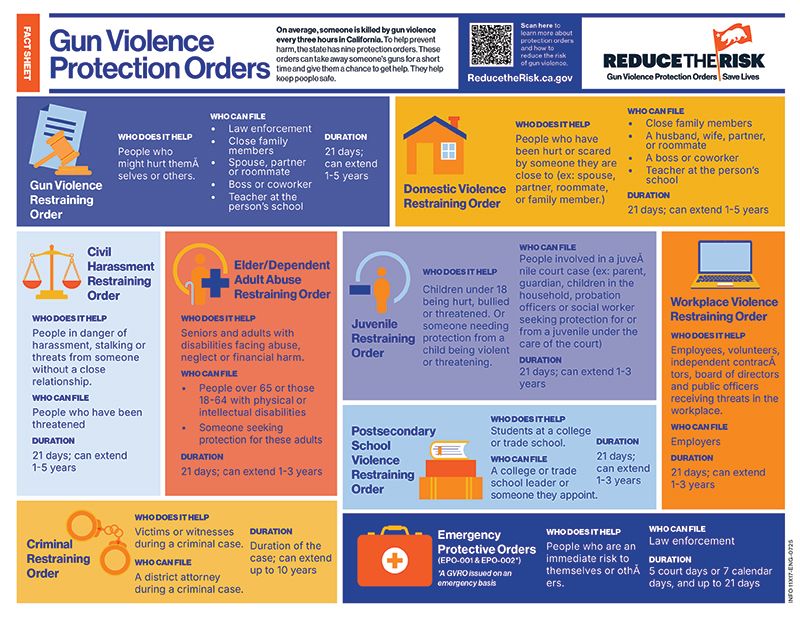
The use of GVROs has grown rapidly. In 2018, Californians filed 424 GVROs. By 2023, that number rose more than fivefold to 2,073.
Eligible petitioners include law enforcement, family members, household members, co-workers, school officials, and intimate partners. Law enforcement may also request emergency GVROs lasting up to 21 days, with courts able to extend orders for up to five years after a hearing.
Resources are now available in 14 languages at reducetherisk.ca.gov.
“The data shows that protection orders like Gun Violence Restraining Orders do work,” said Chris Dargan. “We’re hoping to build on that momentum.”
All photos provided by ACoM.