More Than Words Published – Finding Myself Through Writing
We’ve all taken the classic English class. You know the one where we’re asked to write those “boring” poems, short stories, and five-paragraph essays. For many, it ends there because it’s just another grade, another assignment. But stay for the ride and somewhere between the forced metaphors and the scribbled margins, you realize that writing becomes more than just words on a page. Gen-Z Contributor Khushi Mehta shares her journey to writing her first book in high school.
When I was younger, I loved stories. Whether it was my parents narrating them or the books I devoured during quiet afternoons, there was something magical about being transported into another world through someone else’s words.
But when I got to high school, something shifted. As you grow older, you begin to think more about yourself, your place in the world, and everything in between. My thoughts started to feel heavier, more philosophical. One evening, as I was scrolling through TikTok, I came across a poetry page where a young author was narrating her work. Her words weren’t about fantasy worlds or far-off places. They were about change, self-growth, and pain. And suddenly, I was crying. Not because I was sad, but because I saw myself in her poetry.
I followed her account and listened to her pieces every day. That simple discovery led me down a rabbit hole of reading personal narratives and reflective writing shared by strangers online. I was blown away by how just a few lines, could make someone feel so deeply. That’s when I decided to start writing my own poetry.
Whenever I had thoughts swirling in my mind that I couldn’t say out loud, I would sit down and write. For me, writing wasn’t just putting words on paper – it was translating emotions into something real and readable. It wasn’t about making things rhyme or sound fancy. I’ve never enjoyed writing the kind of poetry that’s full of elaborate metaphors or perfectly rhymed lines. I prefer simplicity – poems that are raw, clear, and real. The kind of writing where someone can read it and immediately see themselves in the story. Where they don’t just understand it – they feel it.
And somewhere along the way, I realized something: you don’t always have to talk about something to understand it. Sometimes silence is enough, as long as you have a place to put your thoughts. Writing gave me that place. It became my quiet companion, a mirror, a release, a translator for everything I felt but didn’t know how to explain. There’s something profoundly human about taking a feeling and turning it into something you can see on a page. It’s like you’re building a bridge between the chaos in your head and the clarity of understanding.
It starts to echo back at you, reflecting thoughts you didn’t know you had, feelings you didn’t know you were carrying. Some pieces begin to resonate with your inner self in ways you never imagined. And that’s when writing becomes something deeper: a quiet conversation between who you are and who you’re becoming.
I made myself a promise: write at least four poems a week. It didn’t matter if they were messy or unfinished; what mattered was that they were honest. As the weeks went by, I filled page after page with poems about love, friendship, family, growing up, and all the complicated parts of change.
One of those poems came from a moment of reflection, about how fast everything shifts when you grow older. I wrote:
Somewhere along the way, things started to change.
The mirror became more than just a reflection,
Words and opinions suddenly started to hold weight.
Mistakes were no longer lessons, but setbacks,
Setbacks that pushed you further behind in the race.
It hurts, once excelling in academics in middle school, now just average in high school.
I miss when we used to have recess, moments of freedom,
Now it’s just lunch, where my mind stays on academics and plans.
Playtime has turned into responsibilities.
Writing that poem was one of those moments where I realized how deeply personal poetry had become for me. It helped me put into words what I couldn’t even fully explain to myself. And I thought that maybe, just maybe, someone else would read those lines and feel a little less alone.
Doing this during junior year of high school wasn’t easy. Between classes, AP exams, volunteering, and club meetings, my days were already full. But still, I carved out time, late at night, during lunch breaks, whenever I could, because writing had become a part of me. It wasn’t just a hobby anymore. It was how I coped, how I processed, how I healed.
Eventually, I thought, if these poems help me, maybe they can help someone else too. So, I posted a few online, and to my surprise, they started gaining views. Encouraged by the response, I was determined to publish a book.
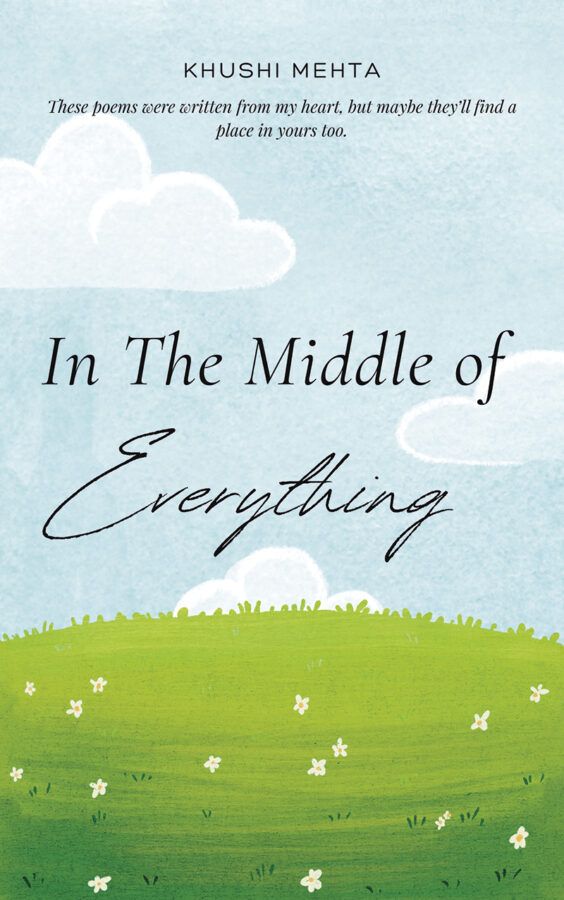
Designing the cover, editing the manuscript, and formatting the pages wasn’t easy. There were moments of self-doubt and technical headaches. But in the end, I published In the Middle of Everything, a short, heartfelt collection of poems that reflect the moments we all go through, even if we never say them out loud.
It’s a small book, but it carries big feelings, the kind you can’t always say, but can always write.
Featured image: Adobe Stock.