Future.Tech: The Cyber-Physical Future – South Asian Silicon Valley Legends Predict
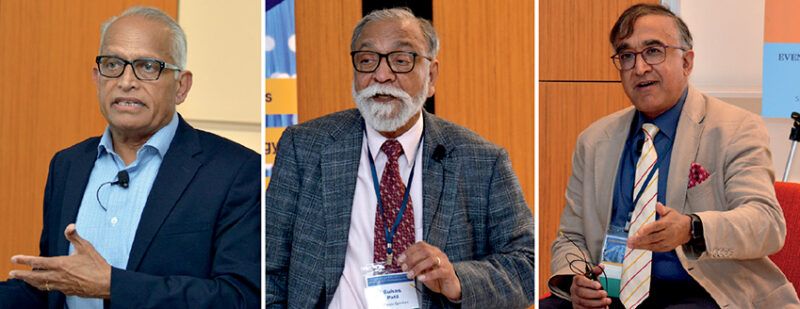
(L-r) Dr. Chandrakant Patel presenting his vision for cyber-physical engineering, Dr. Suhas Patil sharing his journey as a “misfit” entrepreneur who revolutionized chip design, Dr. Ronjon Nag discussing the intersection of AI and biology in longevity research at the South Asian legends panel (Vansh A. Gupta/Siliconeer).
When three South Asian engineering legends – Chandrakant Patel, Suhas Patil, and Ronjon Nag – come together, expect bold visions. Their message: the cyber age is over, the cyber-physical age has begun, demanding engineers who combine physical science depth with cyber breadth. A Siliconeer report.
The Cyber-Physical Future
Being in Silicon Valley, we are often lost in the software and AI soup. For the first time in ages did we hear innovation in the physical world. “The future is cyber-physical. It’s not cyber, it’s cyber-physical,” declares Chandrakant Patel, who pivoted from disk drives to chips to data centers.
Half of America’s 4,000 cardiothoracic surgeons are retiring. Who wants 22 years of training for $60,000 annually when you could be a YouTube influencer? The solution: cyber-physical systems merging hardware and software—remote surgery, robotic assistance, domain-specific AI on private hospital data.
“If AI is so great, can we build the Golden Gate Bridge today with less lifetime energy than it took in 1933?” Patel challenges. His AI return formula: Energy Saved / Energy Used by AI. “You can’t measure it in dollars—inflation is bullshit. But joules is joules.”
The Time is Never Right
Suhas Patil focuses on disruption cycles. “Technology develops in steps. Every transition gives entrepreneurs opportunities to do things differently.” As a “misfit” professor at University of Utah, he built a silicon compiler that designed chips in months instead of years when Silicon Valley said it was impossible.
“Large companies may even ignore what entrepreneurs are saying,” Patil notes. That’s exactly when opportunity strikes. Don’t wait for perfect conditions.
From Silicon Valley To Bio Valley
Ronjon Nag sees the frontier merging biology with semiconductors. “The only existence proof of intelligence is us. But we don’t run on silicon. We run on carbon and cells.” After 40 years in AI, he’s pursuing a vaccine against aging.
“Can we cure all disease in our children’s lifetime? I almost laughed when I first heard that. But now I think it might be possible.” GPT-4 has 3-5 trillion parameters. The human brain has 100 trillion neural connections. “We’re only 30 times away.”
The challenge: the next 50 years won’t be about overpopulation but underpopulation. The solution? AI scientists reading 200 million papers to determine which approaches work.
The T-Shaped Engineer
All three converge on one message: become T-shaped. Physical science depth plus cyber breadth.
“If you’re only physical, you’re a dinosaur,” Patel states. “What are mechanical engineers waiting for? Take over the entire stack.”
Nag’s advice: “Aim for big ideas, work backwards, shield your moonshots from pessimism.” In November 1903, the New York Times said flight would take 10 million years. The Wright Brothers flew that December.
The 21st century is the cyber-physical age. Mechanical engineers and bio engineers, your abstraction is over. Time to take over the whole tech stack.