The AI Aristocracy – Utopia for the Few, Disruption for the Masses
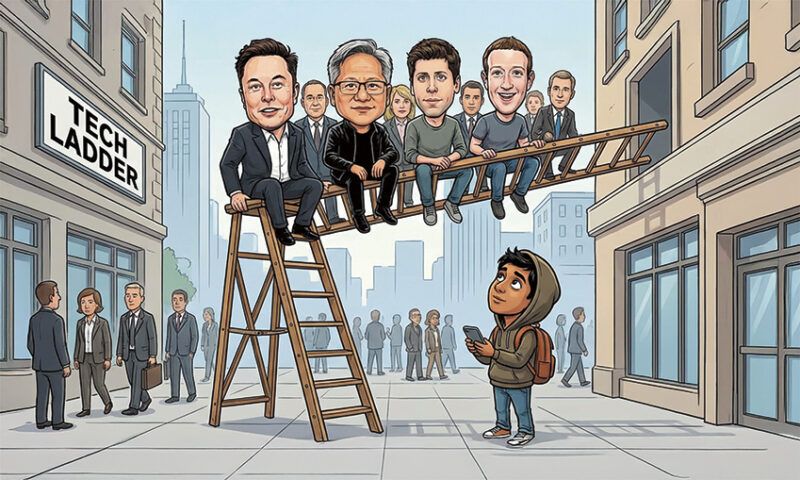
Tech billionaires promise a labor-free utopia, but as robots hit our streets and layoffs hit the inboxes, the next generation workforce faces a reality check. Vansh Gupta explores where we stand amidst the new “Industrial Revolution.”
“Work will become optional.” “Money will be irrelevant.” It is a seductive vision: a technological utopia where humans pursue passion projects while AI robots handle the mundane tasks at hand. Everyone will be well-off and work will become optional. It is the promise of Elon Musk, Sam Altman, and the pantheon of tech leaders recently enshrined on the cover of Time Magazine as the 2025 Persons of the Year.
Recreating the iconic 1932 “Lunch atop a Skyscraper” photo, the ironworkers have been replaced by the billionaires controlling the future: Musk, Altman, Jensen Huang, Lisa Su, Demis Hassabis, Dario Amodei, Fei-Fei Li, and Mark Zuckerberg.
The symbolism is stark. The rough hands of labor that built America have been swapped for geeks and nerds who are capitalizing on the promise of AI. Five of these figures alone control a combined wealth of nearly $870 billion. While they look at the world from their steel beam with optimism, the view from the ground is far more complex.
We are told we are heading toward a life of leisure and autonomy. But to many, it feels like we are barreling toward a “Wall-E” future: a world where human agency surrenders to automation, and the gap between the billionaires and the common man widens exponentially.
For the last two years, the AI conversation focused on “Generative AI.” But 2025 has shown us that AI is no longer confined to the cyber space. It has entered the physical world, and that is where the disruption is becoming tangible.
We see it in Bay Area where Waymo robotaxis are going from San Francisco to Palo Alto during peak traffic. There is no human in the driver’s seat. We see it on our sidewalks, with food delivery robots trundling along, replacing the gig-economy delivery driver.
Now, we are seeing the dawn of the humanoid robots. Tesla’s Optimus and the 1X “Neo” home robot are no longer just prototypes. These are robots capable of folding laundry, sorting factory parts, and performing complicated physical tasks. These are capabilities once thought decades away. Jensen Huang of Nvidia insists these machines will be “assistants,” not replacements. The math of capitalism suggests otherwise.
If a robot can deliver dinner or assemble a car door cheaper than a human, the human role inevitably diminishes. In fact, we are already witnessing mass layoffs and job displacement with the increasing integration of another form of AI/automation in the workforce. Salesforce, Amazon, Goldman Sachs, Meta have all laid off employees throughout the year.
We can’t ignore the looming reality. Where will the current and future workforce go from here? What will humans do as automation and AI take center stage in productivity? CEOs are raising billions in the AI revolution, but do they have an answer to how humanity will progress? Is the answer Universal Basic Income (UBI) or “Universal High Income”?
To bridge the gap between human obsolescence and survival, the “Architects” propose a radical solution: UBI. Elon Musk has rebranded the concept as “Universal High Income,” predicting that AI-driven abundance will make goods so cheap that money itself becomes secondary. Sam Altman has floated “Universal Basic Compute,” where citizens own a share of the AI’s processing power.
Even the “Godfather of AI,” scientist Geoffrey Hinton, concedes that some form of UBI will be mandatory. “I advised them [Downing Street] that universal basic income was a good idea,” Hinton said, warning that AI will take “lots of mundane jobs.” However, he cautions that cash handouts settle the grocery bill but not the psychological void. “That won’t deal with human dignity,” Hinton warned, “because people get worth from their jobs.”
Similar sentiments are echoed by investor Howard Marks of Oaktree Capital. In a December memo, he called the employment impact of AI “terrifying.” Marks notes that jobs provide structure, community, and self-respect.
“I worry about large numbers of people receiving subsistence checks and sitting around idle all day,” Marks wrote, drawing a chilling parallel to the opioid crisis that followed the hollowing out of American manufacturing. He questions the economic physics of the UBI dream: “Where will the money come from for those checks?” I ask whether the billionaire “architects” behind these ideas will fund those checks.
The data supports these worries amongst the current workforce. According to Pew Research, 52% of American workers are “worried” about AI. Deloitte’s 2025 survey reveals that nearly half of Gen Z feels financially insecure, with many questioning if the corporate ladder is even worth climbing. In fact, the Gen Z workforce is more inclined towards a better work-life balance over prestige.
The IMF explicitly warns that in advanced economies like the U.S., 60% of jobs are exposed to AI disruption. While half might benefit from productivity gains, the other half faces reduced hiring and lower wages. We are already seeing this “hollow middle” form, with tech companies posting record profits while conducting mass layoffs. Goldman Sachs reports that young tech workers (aged 20-30) have seen unemployment rise nearly 3 percentage points since early 2025—a “hiring headwind” that creates a bottleneck for new graduates.
So, where does this leave the workforce? Specifically, the students currently in high school and college?
The World Economic Forum predicts 92 million jobs will be displaced by 2030. While they project 170 million new jobs from the AI revolution, there is a concerning “skills gap” brewing. A truck driver or delivery driver may not become a prompt engineer overnight.
For the next generation, the “learn to code” advice of the 2010s seems a bit outdated these days. Here is where the real opportunities lie as we barrel towards work automation.
Embrace the Physical: Paradoxically, the safest jobs might be the ones that require messy, complex physical work. Geoffrey Hinton’s advice was blunt: “A good bet would be to be a plumber.” Electricians, nurses, and specialized tradespeople face a physical world too chaotic for current robots to master easily. The “blue collar” roles may soon become the “gold collar” careers of the 2030s.
The Human Element: Deloitte notes that soft skills like empathy, leadership, and strategic thinking are skyrocketing in value. AI can analyze data, but humans are required to negotiate delicate deals or lead a team through a crisis. OpenAI’s own chief economist, Ronnie Chatterji, says he is teaching his kids critical thinking and emotional intelligence to prepare for the future.
The Know-It-All: The winners will not be those who ignore AI, but those who command it. As the saying goes, “AI won’t take your job, but a person using AI will.” Students must become “AI-native,” treating these tools as extensions of their own intellect rather than replacements for it.
We are standing at a crossroads. One path leads to the utopia Musk and Altman describe. A world of optional work and “Universal High Income.” The other leads to a stratified society where the “Architects” on the steel beam own the robots, and the rest of us compete for what is left. There is another way. One where technology doesn’t control us, but we control the technology. Unplug when needed. Spend time in nature. Learn skills in the physical world. Avoid trying to out-machine a machine. Be more human.
What we really have to ask is whether we are all heading for a future that distributes the benefits of AI equitably, or simply concentrates power among the few.
Image: Adobe Stock/Google Gemini