Gubernatorial Candidate Tony Thurmond Presents a Progressive Outlook
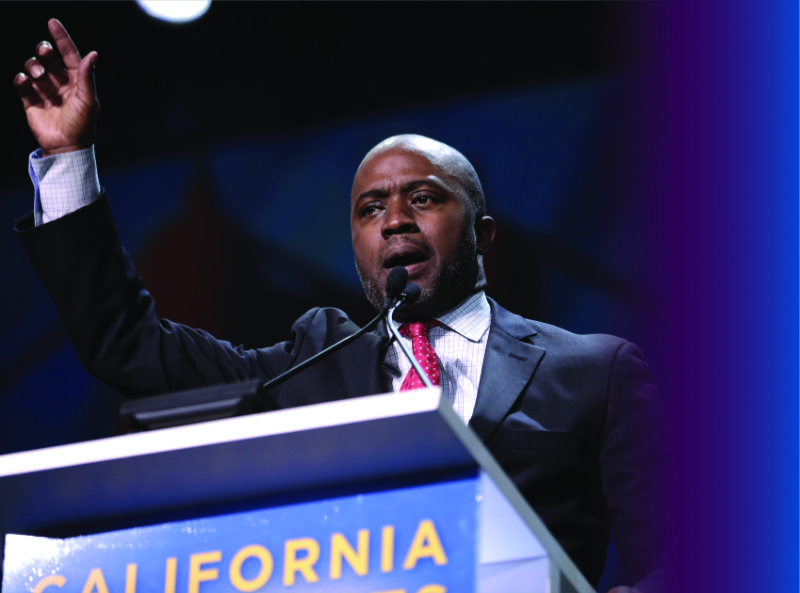
Gubernatorial candidate Tony Thurmond is making a progressive case for California’s future, centered on single-payer healthcare, affordable housing, immigrant protections and economic relief for working families.
In a media briefing on April 30, hosted by American Community Media, Thurmond laid out an expansive platform as he seeks the Democratic nomination for governor. The 57-year-old state superintendent of public instruction has positioned himself as a candidate shaped by immigrant roots, poverty and nearly two decades of public service.
Thurmond’s campaign is rooted in his personal history as much as his policy agenda. Born at Fort Ord to a Panamanian immigrant mother who died of cancer when he was six, Thurmond and his younger brother were separated from their two siblings and sent to live with an older cousin in Philadelphia whom they had never met. There, they lived on food stamps and government assistance.
He later worked in restaurants and social work before entering elected office. Over the last 18 years, Thurmond has served as a city council member, school board member, state legislator and twice as state superintendent.
Now, he is making his case for governor with a platform that includes instituting single-payer healthcare, building two million housing units by 2030 and abolishing Immigration and Customs Enforcement.
Patients Over Profits
On healthcare, Thurmond pointed to a personal loss as the reason he believes California should move toward a single-payer system.
“I had a brother who lost his job and lost his insurance right at the time that he developed a very rare liver disorder,” he said. “My brother didn’t drink or smoke, and because he didn’t have insurance, he couldn’t see a doctor, and his condition worsened to the point that he lost his life. He was only 35 years old. No person should lose their life simply because they don’t have health insurance.”
Thurmond criticized the Republican budget reconciliation act known as the “One Big Beautiful Bill,” calling it “the big ugly bill,” and warning that it would have devastating effects on Medi-Cal enrollment and Affordable Care Act premiums.
“Medi-Cal is a federal entitlement, and that means if you qualify, you get it,” he said.
He pledged to work toward flipping congressional control to a Democratic majority in order to reverse the bill’s effects and “to build out a healthcare system that places the emphasis on patients over profits.”
Housing, Affordability and School Land
Affordable housing was one of the most detailed parts of Thurmond’s platform.
He proposed unlocking surplus school district land across every California county to build 2 million housing units by 2030, with the state providing startup funding for pre-development work.
“This doesn’t mean that if you’re a school district employee, your employer is going to be your landlord,” he said. “It just means that districts will now have resources to work with developers who can build housing for teachers and classified staff” — including, he said, nurses, public safety workers and city and county employees.
Thurmond is also backing a voter-decided $10 billion affordable housing bond and calling for down payment assistance grants for first-time homebuyers.
On rent control, he said he supports expanding it statewide while still allowing property owners a reasonable annual increase to cover maintenance costs. He also called for reviving urban redevelopment agencies and providing low- or no-interest loans to urban small businesses facing permitting burdens.
Thurmond also proposed allowing students from municipalities in Mexico near the border to dually enroll in California high schools and community colleges. He argued that the idea could help address school district revenue gaps caused by declining enrollment, strengthen community college numbers and fill workforce shortages in understaffed sectors.
“We are experiencing a crisis of supply and demand. The state has not invested in affordable housing in over a decade,” he said. “The governor and the state can’t just make prices go down, but we can create conditions that ultimately will support bringing costs down in two ways. One, immediate relief for Californians in the form of this tax credit … and two, building more housing.”
Taxes, Childcare and Economic Relief
To fund his housing, healthcare, school and job programs, Thurmond proposed taxing “people who have more than, say, $150 million in assets” to support a tax credit for working- and middle-class Californians.
He has also endorsed the California Billionaire Tax Act, a one-time 5% tax on the roughly 200 California residents with a net worth over $1 billion.
Thurmond also called for a universal childcare program, framing it as both relief for working parents and support for the women- and women-of-color-led small businesses that largely provide childcare.
Research shows that while such a program could cost up to $21 billion a year to subsidize all families, it could also add up to $23 billion to the state’s economic output, effectively paying for itself — partly by enabling more than 100,000 mothers to enter the workforce.
Taking on ICE
On immigration, Thurmond said he was the first gubernatorial candidate to call for dismantling ICE and said he would “work with Congress to abolish ICE and to create a better system.”
“ICE was supposed to be a way to keep us safe, as they said,” he noted. “But who are they keeping us safe from? Look at who’s being deported — people who work as childcare workers and farm workers. Meanwhile, people are losing their lives for speaking out against ICE.”
Thurmond described federal immigration enforcement as being driven less by public safety than by private profit. He pointed to private immigration detention companies GEO Group and CoreCivic, which together donated nearly $2.8 million to President Trump’s 2024 campaign.
As of last year, private companies operated all of the top 20 detention centers nationwide, and 86% of ICE detainees were held in facilities run by for-profit companies. Eight such centers are in California.
“I believe that the whole purpose behind President Trump’s dangerous and reckless immigration policy is to help his friends make money,” Thurmond said.
He noted that he has already passed legislation keeping ICE out of California schools and hospitals, supported legislation taxing and banning for-profit prisons and is now sponsoring state legislation that would impose a 50% tax on any company operating an ICE detention center in California.
“Core Civic is already telling its investors that they may have to leave California. Good riddance,” he added. “Because there is a financial objective to this immigration policy, we have to hit them in their wallet. We have to meet them where they are.”
Thurmond said that, as governor, he would direct the California Highway Patrol to arrest ICE agents who violate state law, “create a real pathway to citizenship” and restore health coverage to undocumented immigrants.
“It will save money,” he said, “as people are not going to emergency rooms for care that could be done in a more preventative way.”
In the Polls
Thurmond was also asked about his standing in the governor’s race after failing to qualify for the May 5 CNN gubernatorial debate because his polling numbers were below the network’s 3% threshold.
Recent polls show Thurmond’s support between 1% and 2% among likely voters.
He rejected the idea that polling should define the race.
“I just don’t think that polls elect anyone. People do,” he said. “I’ve been in five elections where I was out-polled, outspent and flat-out told that I would never win.”
Thurmond also noted that the Los Angeles Times scored him the winner of an eight-candidate debate two days earlier.
“My name is on the ballot. I’m in it to the end, and I’m running to win,” he said. “I don’t want to work for another governor. I’m not looking for a job in anybody’s administration. This is the last office I’m ever going to run for.”
Image courtesy of American Community Media