The Innovation Gambit – Two Paths to Tomorrow

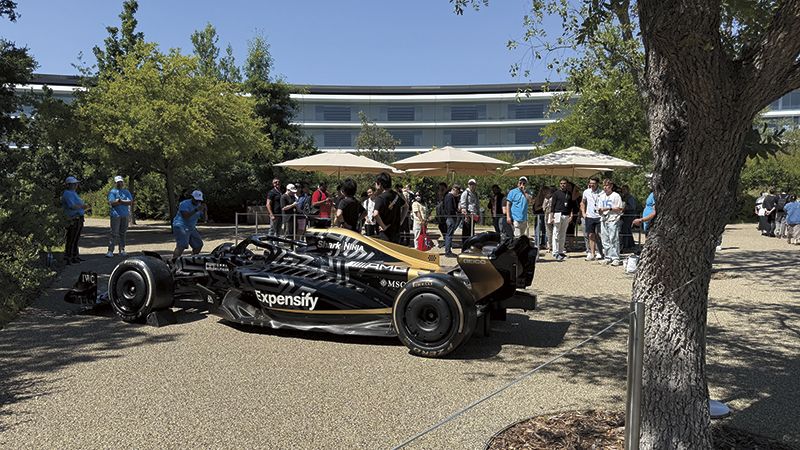
Glimpses of WWDC 2025 at Apple Park (Vansh A. Gupta/Siliconeer).
In our last issue, AI told us “the smartphone is stupid.” After attending the WWDC 2025, and witnessing Google, Meta, and the Ive-Altman collaboration unfold, we’re realizing a theme behind this. There are two different approaches to innovation right now. One optimizes what we have while the other questions whether we should have it at all, write Siliconeer Editors Vansh Gupta and Janam Gupta.
WWDC 2025 showed Apple innovating within the lines they drew. Meanwhile, Jony Ive and Sam Altman plan to redraw the entire canvas. Both approaches matter—but they’re playing completely different games. This doesn’t even consider Google’s and Meta’s latest bet on glasses and AI. To save time, we will focus on real innovators.
“Apple seems to find this WWDC like a chore.” A sentiment shared by many but without admission. That wasn’t entirely fair. Apple wasn’t being lazy—they were being strategically conservative. Maybe there is method to Apple’s non-madness. In the age of Appletinis, this was more like mellow apple juice. Not that we have anything against apple juice.
The Simplification Strategy
We observed a theme of simplification this year. Apple spent the entire keynote making existing complexities more manageable. We had the pleasure of seeing a more integrated system throughout its device line up, improved CarPlay, photos that organize themselves, ChatGPT helping Xcode, and Siri that anticipates your needs instead of waiting for commands. A clipboard history, seeing where you have been on Maps, hold assist… I mean the list goes on and on with the mini refinements.
These aren’t necessarily revolutionary, but innovative. Advancements like these make the overall experience more sublime. Apple is solving real problems. And for a company managing billions of users across an integrated ecosystem, that’s the responsible approach.
Apple Intelligence: Smart Enough
Most gen-AI LLM models dish their computing out to some data server, which poses a huge security and environmental risk. Apple’s system runs completely on-device. Yes, it’s less capable than other LLMs today, but it’s also completely private—even from Apple itself.
Apple looked at the AI landscape and said: “We can make this better for our users without fundamentally changing how they interact with technology.” They’re improving the smartphone experience rather than replacing it.
Apple’s Innovation Philosophy: Evolution, Not Revolution
Dr. Nitin Aggarwal of San Jose State University shares that true innovation often comes through transaction cost reduction and continuous improvements. These are steps to radical changes. Apple embodies this perfectly.
They’re not trying to disrupt their own successful model. They’re trying to perfect it. Apple built a trillion-dollar business on the smartphone—why would they cannibalize it prematurely?

The “liquid glass” interfaces, gesture controls, and seamless ecosystem integration represent sophisticated design changes within established lines. These are baby steps on what Apple envisions is the future. The glass-like interface makes way for transparency throughout its devices. Maybe we are moving beyond just screens but through a different form factor, not seen yet. That’s probably what billions of users want. Or is it?
While Apple dawdles within its existing boundaries, Jony Ive and Sam Altman are betting those boundaries shouldn’t exist at all.
Ah yes, Jony Ive, once besties with Steve Jobs. If Steve was the brain, then Jony was the heart behind all of Apple’s top hits. iMac, iPad, the original iPhones… Jony was in Apple back when Apple disrupted and didn’t just rave about “liquid glass,” calling it a revolutionary redesign. It’s innovative, not revolutionary.
The Philosophy of Fundamental Change
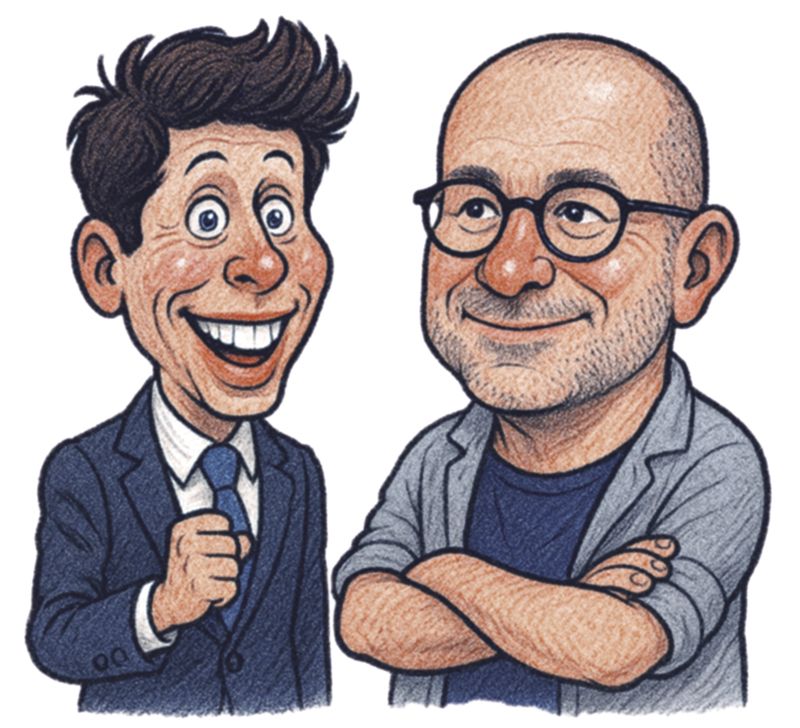
Through IO, now owned by OpenAI for $6.5 billion, Ive and Altman are not trying to make smartphones better—they’re trying to make it obsolete. Again, Siliconeer has predicted that smartphones will become the equivalent of present day Blackberry devices.
Many Apple alumni will be joining Ive and Altman in this venture. Evans Hankey: Ive’s successor who maintained design excellence until leaving Apple in 2023, Tang Tan: Led iPhone and Apple Watch development until 2024, and Scott Cannon: Apple veteran who co-created breakthrough email app Mailbox. Even Laurene Powell Jobs is backing this vision through Emerson Collective. She’s betting that the future of computing will require fundamental disruption, not just evolution.
Building the Post-Smartphone Future
Sam Altman calls their first product the “coolest piece of technology” that will allow people to use AI to “create many wonderful things.” While details remain mysterious, the philosophical direction is clear: ambient intelligence that responds to human intent without requiring explicit interaction.
Your AI companion notices you’re running late and automatically coordinates transportation, adjusts your calendar, and briefs you on relevant information—all without you touching anything. That is the current speculation.
This isn’t about making devices better—it’s about making physical device interactions disappear entirely. That’s disruptive innovation.
Ive understands that the next iteration of personal computing requires questioning whether smartphones should be the primary interface between humans and digital intelligence.
What This Means for the Future?
Apple’s incremental innovation serves the billions of people who need their current tools to work better, not differently. The enumerable simplifications, ecosystem integration, and privacy focused AI represent genuine advances that improve daily life for existing users.
Ive and Altman’s disruptive innovation serves the future—building interaction paradigms that don’t exist yet but might define the next decade of human-computer relationships.
The industry needed both approaches. Think about it. Incremental innovation made smartphones ubiquitous and reliable. Disruptive innovation created smartphones in the first place.
It’s not about choosing between these approaches—it’s understanding that human progress requires both. Maybe, Apple and IO will see each other as friends with benefits, just saying.
Co-Author:
Janam Gupta is a business undergrad student, based in Fremont, Calif. He is Gen-Z editor and social media pundit at Siliconeer.