America, Is Democracy on Thin Ice?
Just over 100 days into President Trump’s return to office, concerns about unchecked executive authority are mounting across the country.
A late April poll by the Public Religion Research Institute found that 52% of Americans — including 87% of Democrats, 56% of Independents, and 17% of Republicans — agreed that Trump is a “dangerous dictator whose power should be limited before he destroys American democracy.” Only 40% of respondents viewed him favorably at the 100-day mark.
In a media briefing on May 9, hosted by American Community Media, a panel of experts discussed whether the democracy of the country is under threat.
Speakers
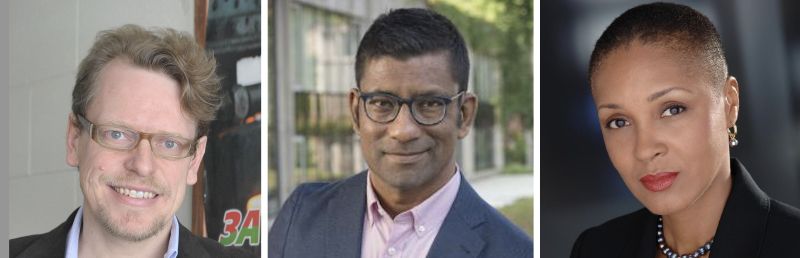
- Lucan Ahmad Way, Distinguished Professor of Democracy, Department of Political Science, University of Toronto
- Aziz Z. Huq, Frank and Bernice J. Greenberg Professor of Law, University of Chicago
- Gloria J. Browne-Marshall, Professor of Constitutional Law, John Jay College of Criminal Justice (CUNY)
Since taking office, Trump’s actions — including increased immigrant extraditions, revocation of legal statuses, DEI bans, and new restrictions on the press — have triggered at least 328 lawsuits nationwide as of May 1.
“That’s the really big difference from cases of slower-developing authoritarianism in places like Hungary, Turkey and India … is this rapid, open disregard for court rulings and legality,” said Lucan Ahmad Way.
One influential survey by Bright Line Watch asked over 500 U.S. political scientists to rate American democracy on a scale from 0 (complete dictatorship) to 100 (full democracy). The score dropped from 67 after Trump’s election to 55 just weeks into his second term.
“What we’re seeing now are subtle legal or semi-legal abuse,” Way added. “From defamation suits to online harassment, that increase the costs of even mainstream opposition.”
Way noted that fear is reshaping public behavior: “We see donors who are scared to give to the Democratic Party or left-wing causes for fear of retribution. We see self-censorship in the media.”
Despite a likely Supreme Court challenge, Way believes a third Trump term is on the table. “would be quite surprised, assuming Trump’s health holds, that he doesn’t go for a third term. At this point, it’s the likely scenario.”
Trump has floated the possibility publicly, including in a March interview with NBC where he said he was “not joking” about seeking a third term. He mentioned one potential route: Vice President JD Vance could run and step aside once elected. “But there are others, too,” Trump added.
The 22nd Amendment clearly prohibits a third presidential term, stating: “No person shall be elected to the office of the President more than twice.” But legal scholars argue other constitutional provisions already disqualify Trump from holding office.
“In my view, there are other provisions in the Constitution that apply to President Trump, precluding him from holding the office that he holds now,” said Aziz Z. Huq. “Section 3 of the 14th Amendment bars individuals who engage in rebellion, insurrection, or provide aid and comfort to either rebellion or insurrection. This language plainly and comfortably fits President Trump, given his actions on January 6, 2021.”
Still, the Supreme Court ruled unanimously in Trump v. Anderson on March 4, 2024, that only Congress — not individual states — can enforce Section 3’s disqualification clause.
Trump’s second term has already disrupted longstanding political, legal, and cultural norms — and that, Huq suggests, may give Democrats new latitude.
“From the ‘90s onwards, the Democrats, like many left-of-center parties around the world, came to accept a set of economic policies — deregulation, open markets, financial liberalization — usefully but roughly called ‘neoliberalism,’” he said, Which ended up costing them working-class support. “Democrats have much more space to pursue policies that directly speak to the economic pressures that drive authoritarian populism than they did even five or 10 years ago.”
But Democrats, some argue, are still lacking a coherent vision.
According to Gloria J. Browne-Marshall, there’s no forward-looking plan. Fear is Trump’s strategy: fear of immigrants, of diversity, of economic insecurity. And Democrats haven’t figured out how to counter that with something bold.
She warned that the erosion of rights once applied selectively is now being extended to the broader population.
“When we think about the abuses of power, we had grown used to these methods of undermining constitutional protections when it came to people of African descent and other communities that had been politically or economically marginalized, but it was always assumed in this country that it would have a limit there,” she said.
“Authoritarian power isn’t appeased with acquiescence and capitulation. It only grows stronger.” Browne-Marshall emphasized. “he focus of all this is not just to gain power, but to have power as we go into the year 2045, when this nation becomes majority people of color. That’s what this is about: the fear of diversity.”
She invoked Martin Luther King Jr.’s final book, Where Do We Go From Here: Chaos or Community? Dr. King said if this country truly embraced equality, it wouldn’t want democracy. “He understood that sharing power is very difficult. In a country that pretends it shares power, it’s even more difficult when we try to make that sharing of power a reality.”
Images provided by ACoM.